Wednesday, December 17, 20008
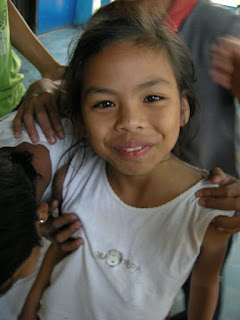
Today I went to the city orphanage of Phnom Penh (way on the outskirts of the city) and played with the HIV children and the disabled children (cerebral palsy, etc.). It was great! I was very impressed with the facilities, all new, clean, spacious, kids well taken care of. Good to see among so much usual squalor, in a developing country where one would expect less. Even in the United States (or perhaps especially in the U.S.), state-run care facilities that I have witnessed are usually dismal buildings with minimal care by an apathetic, under-paid staff. So it was so wonderful to see that here there was a positive space for these poor children. The only disadvantage, I felt, was that the kids with HIV, who were otherwise fully functioning, physically and mentally, were mixed in with the disabled, and did not have much opportunity for creative stimulation at their level.
So I think my visit really offered these kids a chance to go for it and have fun and play -- freely and fully. They were so engaged and gung-ho! I was surprised. Usually when I propose a game and ask ‘who wants to try, who wants to go?’, nobody raises their hand, most everyone shy and hesitant to be the first. Here lots of hands shot up in the air and the kids were ready with such great creative ideas for fun (and funny) movement and sounds!


Cambodia - observations, experiences
 Everyone has a moto (a Vespa-like motorcycle). This is the general mode of transportation in Cambodia. In fact, there aren’t really any taxis or buses except for long-distance travel, you simply hop on the back of a moto to go wherever you’re going. That or a tuk-tuk. And there's no limit to how many or how much you can pile on. "No problem," goes the motto of the moto drivers. I saw a moto with six people on it, including a baby dangling from her mother's arms. I also saw a moto with four big television sets piled on the back (with no protective packaging, mind you). And then of course you have me and my huge luggage -- see photo to the right (my 4' stilts are sticking out on the other side). And off we go into the crazy traffic of Phnom Penh! No problem!
As I may have mentioned, I find the Cambodian people to be extremely friendly. Especially children are very open and curious. Little kids passing you on the road will most certainly shout out "Hello! Hello!," invariably followed by giggling. Even way out in the field, if they see me, they will holler "Hello! Hello! Hello! Hello!" It's funny. Cute. They do it with such excitement. I bike by on a little path past a house, and the family goes "Oh, look, a barang (i.e. foreigner)!... Wave to her!... Hello, hello!" Even adults when driving by on their moto, turn and shout out a friendly "Hello!" Men may stare at me, but not in an uncomfortable way. It's fairly easy to make friendly contact and conversation. Of course for conversation it helps if they speak English (as my Khmer is limited). Which a lot of them do. The younger people. And the older men and women often speak French, a remnant from colonial times. Since I speak French that works for me. Then, on the other hand, there are the times of complete communication breakdown, when I say something as simple as "bai" (rice) which I cannot possibly be mispronouncing and the woman selling rice patties looks at me like I'm an alien. Since I very much want to learn Khmer and pride myself in my easy ability to pick up languages, that frustrates me! Bai? What don't you understand?! Argh.
There are a lot of children begging for food and money in the cities (Battambang, Siem Reap, Phnom Penh) and it is hard to know how best to deal with it. One little girl no more than 4 or 5, extremely dirty and barefoot, came up to me as I was sitting at a street-food vendors cafe table eating. She wanted money. I bought her some food, which they wrapped up for her to take away. She did not look happy, however, at being given food. I wondered what she was going to do with it. Was she sent out to beg by a Fagin-type leader, who would collect everything they get? If with her parents, would they take the food? Would she get to eat it? However, later when I walked down the street, I saw her sitting on the sidewalk eating. Good, I was glad. Often children are sent out by their parents to beg, or by a gang leader. You don't want to encourage this practice so it's not the best thing to give them money. And yet you want to help. It's hard to know when they really just want help to get something to eat, and when they are foils for someone else's scheme. And there are so many you can't give to everyone, you really can't. Some people make it a principle to never give at all. (And instead, help by supporting aid organizations.) Besides children, lots of mothers with babies on their arms, and old women.
Here's an interesting little tidbit: Cambodian women like to wear pajamas as street clothes. I mean, a lot. It's curious to me. If only for the fact that the weather is so warm and they're walking around in flannel pajamas, aren't they hot?! I find it funny. Grown women walking around in Hello Kitty pajamas or little bunny prints or ducks. If a person was walking down the street in pajamas in the U.S., someone would be calling the men in white coats. Maybe not in New York City, where anything goes, but otherwise. Apparently, as I was told, it started out as a trend for rich Cambodian women to demonstrate that they did not have to work, so they could go around all day in lounge wear. Then it became fashion somehow and women working wear them and so does everyone else.
 Shopping at the market - in pajamas
[Further observations to follow]
Afesip - Phnom Penh & Kampong Cham
December 12-16
Next I continued on to the two other Afesip centers -- Tamdy center outside Phnom Penh, and the center for the younger girls (under 18, as young as 4) way out in the countryside towards Kampong Cham (northeast of Phnom Penh). We drove for two hours to get there, the last part bumping along dusty dirt-roads, past traditional houses, with cattle roaming, children playing and school kids biking home. When I arrived in Cambodia it was the end of the rainy season and there was mud everywhere. In just a few weeks everything's turned to dust.
Here are some more photos!


On the way to the center near Kampong Cham


"AFESIP-Kampong Cham Rehabilitation and Vocational Training of Basic Skills Center"
And above right, the upstairs hall where the girls sleep (on mats that they pull out at night).


All new plates and pots and pans, yey! / And then some clowning in the sewing center-cum-theater!....


Latiya (Liya) got a kick out of dressing up in my clown costume, and so did Sareka and Kakada. Those clown converses were a big hit!


Standing tall! While Opeyka poses.
Tamdy center outside Phnom Penh:


Srey Leak and Ratchana get creative and clown away!


Next I continued on to the two other Afesip centers -- Tamdy center outside Phnom Penh, and the center for the younger girls (under 18, as young as 4) way out in the countryside towards Kampong Cham (northeast of Phnom Penh). We drove for two hours to get there, the last part bumping along dusty dirt-roads, past traditional houses, with cattle roaming, children playing and school kids biking home. When I arrived in Cambodia it was the end of the rainy season and there was mud everywhere. In just a few weeks everything's turned to dust.
Here are some more photos!


On the way to the center near Kampong Cham


"AFESIP-Kampong Cham Rehabilitation and Vocational Training of Basic Skills Center"
And above right, the upstairs hall where the girls sleep (on mats that they pull out at night).


All new plates and pots and pans, yey! / And then some clowning in the sewing center-cum-theater!....


Latiya (Liya) got a kick out of dressing up in my clown costume, and so did Sareka and Kakada. Those clown converses were a big hit!


Standing tall! While Opeyka poses.
Tamdy center outside Phnom Penh:


Srey Leak and Ratchana get creative and clown away!


The girls at Afesip
December 9 - December 11
I am now in Siem Reap to clown at Afesip, at their center for young girls and women rescued from trafficking (sexual slavery) and domestic abuse, a mission started by Somaly Mom.* When I was in Sweden in the summer I read an article about Somaly Mom in a Swedish newspaper, because she had won a Scandinavian human rights prize. And I thought, I am going to Cambodia… and this is exactly the kind of place I want to go to. So I got in touch -- and now here I am! They invited me to perform at the International Anti-Trafficking Day, (officially Dec 12), which was initiated by Afesip and which they celebrated on Dec. 9. I came up with some classic schtick scenarios and just improvised in the moment around it and found myself clowning around with the governor of Siem Reap! (He and Somaly Mom and a whole panel were seated on stage as guests of honor.) It went really well! They were all laughing heaps. The girls sure got a kick out my goofing around with the governor.
I was amazed how loving and sweet these girls are given their recent traumatic past -- so ready to love and laugh! I came back in the evening to join their dance party, and as soon as the girls saw me they rushed towards me screaming with delight surrounding me with hugs! Wow. Such outpouring of love and affection. They had done the same to Somaly Mom (running up and gathering around her so excited and happy) when she arrived, but after all she is the big momma who saved them. They had just met me and I only made them laugh a little… That was a powerful moment to be greeted thus. Their excitement, being so full of life and joy, was wonderful to see. I imagine they are so hungry to live and to love, now that they have the chance; they are making up for lost time!
The next day I came back to do workshops with the girls and we had a lot of fun playing games and acting silly – and they especially loved trying to walk on the stilts!
I got to know one girl more closely, Ren (pronounced "rain"), who spoke English. Somaly introduced us so that Ren could practice her speaking and to show me around the place. Ren is looking forward to finishing her seamstress training so she can open up her own business. She, especially, loved walking on stilts, and managed to do it by herself quite quickly! We took a lot of photos and I promised to send her copies. Over a couple of days we made a nice connection and were just starting to get to know each other. I wish I could have stayed longer. But this time my clown visits were scheduled as shorter stays. The girls have a very busy schedule with school and training to move forward with their life and opportunities. They have a lot of lost time to catch up on! I am glad I was able to come and play with them a little and offer them some joy and fun through the silliness of clowning!
--
* Further information on Afesip and trafficking in Cambodia
Human trafficking, especially the sexual enslavement of young girls, is a serious and rampant problem in Cambodia. Somaly Mom was herself sold off in her early teens and forced to work in a brothel. She did not get away until she was in her early twenties and has since worked tirelessly to fight trafficking and rescue young girls and women from a life as a sex slave. Her organization Afesip runs three centers, one in Siem Reap, one just outside Phnom Penh and a third in the countryside near Kampong Cham. There the girls are offered a safe home, the camaraderie of each other, psychological counseling, education and vocational training. They are given the opportunity to pursue a viable career track doing either hairdressing or sewing. At the end of their training, assistance is given to set them up in their own businesses. Since many of the girls have lost years of schooling, they have many grades to catch up on and they stay at the center for many years until they have completed their education and are fully trained in a vocation.
For more information, go to http://www.somalymom.org and http://www.afesip.org.
--


The Siem Reap center / Waiting for the show to start....
International Anti-Trafficking Day, December 9, 2008


Somaly Mom / Governor of Siam Reap w/Somaly Mom seated at front of stage


Grooving with the girls


Ren and Liya in the sewing room / Ren on stilts!


All gathered together!
I am now in Siem Reap to clown at Afesip, at their center for young girls and women rescued from trafficking (sexual slavery) and domestic abuse, a mission started by Somaly Mom.* When I was in Sweden in the summer I read an article about Somaly Mom in a Swedish newspaper, because she had won a Scandinavian human rights prize. And I thought, I am going to Cambodia… and this is exactly the kind of place I want to go to. So I got in touch -- and now here I am! They invited me to perform at the International Anti-Trafficking Day, (officially Dec 12), which was initiated by Afesip and which they celebrated on Dec. 9. I came up with some classic schtick scenarios and just improvised in the moment around it and found myself clowning around with the governor of Siem Reap! (He and Somaly Mom and a whole panel were seated on stage as guests of honor.) It went really well! They were all laughing heaps. The girls sure got a kick out my goofing around with the governor.
I was amazed how loving and sweet these girls are given their recent traumatic past -- so ready to love and laugh! I came back in the evening to join their dance party, and as soon as the girls saw me they rushed towards me screaming with delight surrounding me with hugs! Wow. Such outpouring of love and affection. They had done the same to Somaly Mom (running up and gathering around her so excited and happy) when she arrived, but after all she is the big momma who saved them. They had just met me and I only made them laugh a little… That was a powerful moment to be greeted thus. Their excitement, being so full of life and joy, was wonderful to see. I imagine they are so hungry to live and to love, now that they have the chance; they are making up for lost time!
The next day I came back to do workshops with the girls and we had a lot of fun playing games and acting silly – and they especially loved trying to walk on the stilts!
I got to know one girl more closely, Ren (pronounced "rain"), who spoke English. Somaly introduced us so that Ren could practice her speaking and to show me around the place. Ren is looking forward to finishing her seamstress training so she can open up her own business. She, especially, loved walking on stilts, and managed to do it by herself quite quickly! We took a lot of photos and I promised to send her copies. Over a couple of days we made a nice connection and were just starting to get to know each other. I wish I could have stayed longer. But this time my clown visits were scheduled as shorter stays. The girls have a very busy schedule with school and training to move forward with their life and opportunities. They have a lot of lost time to catch up on! I am glad I was able to come and play with them a little and offer them some joy and fun through the silliness of clowning!
--
* Further information on Afesip and trafficking in Cambodia
Human trafficking, especially the sexual enslavement of young girls, is a serious and rampant problem in Cambodia. Somaly Mom was herself sold off in her early teens and forced to work in a brothel. She did not get away until she was in her early twenties and has since worked tirelessly to fight trafficking and rescue young girls and women from a life as a sex slave. Her organization Afesip runs three centers, one in Siem Reap, one just outside Phnom Penh and a third in the countryside near Kampong Cham. There the girls are offered a safe home, the camaraderie of each other, psychological counseling, education and vocational training. They are given the opportunity to pursue a viable career track doing either hairdressing or sewing. At the end of their training, assistance is given to set them up in their own businesses. Since many of the girls have lost years of schooling, they have many grades to catch up on and they stay at the center for many years until they have completed their education and are fully trained in a vocation.
For more information, go to http://www.somalymom.org and http://www.afesip.org.
--


The Siem Reap center / Waiting for the show to start....
International Anti-Trafficking Day, December 9, 2008


Somaly Mom / Governor of Siam Reap w/Somaly Mom seated at front of stage


Grooving with the girls


Ren and Liya in the sewing room / Ren on stilts!


All gathered together!
Cambodia the country

The Kingdom of Cambodia is a small country in Southeast Asia, bordered by Thailand to the west and north, Laos to the north, and Vietnam to the east and south. The capital is Phnom Penh with other major cities being Siem Reap (with the Angkor Wat temples where all the tourists go), Sihanoukville (fast becoming a popular beach resort) and Battambang (not much to write home about -- except for being the home of Phare Ponleu Selpak where I worked!).
I entered Cambodia via the border town Poipet and proceeded to Battambang. Thereafter my trajectory -- which I have traced on the map to the right -- is Siem Reap, then Phnom Penh, with excursion to Kampong Cham, and lastly Sihanoukville.
Cambodia
today has around 13 million inhabitants. For some time, the country was known as Kampuchea, which is still what it is called by the Cambodians themselves (Preah Reachenachakr Kampuchea). Of course, to me and perhaps to others, the name Kampuchea conjures up the Khmer Rouge, the brutal regime of the late 1970’s. The people in Cambodia are quite homogenous in the sense that they all speak one language, Khmer (pronounced “Kmai”). Yet there are minority groups such as the Muslim Cham and several small hill tribes in the northwest of the country, as well as many people with Chinese and Vietnamese background. I noticed how different the Cambodians can look from one another – some ‘look’ almost Indian or Sri-Lankan whereas others appear Chinese. But they are all considered ‘Khmer’ whether ethnically so or not.

A little history...
The mighty Khmer empire once stretched across what is now Thailand, Laos and Vietnam. The temples at Angkor Wat are a testament to a glorious past, by many considered the eighth wonder of the world. The vastness of the monuments and the intricacy of their design are simply stunning. Contrast that with the poverty of the country today and the reign of the Khmer Rouge.
KHMER ROUGE
Some of you may know of the Khmer Rouge regime, which ruled Cambodia from 1975 – 1979, essentially converting the entire country into one enormous concentration camp and killing up to 2.5 million people (at the time 2/3 of the population) through execution, mass starvation and generally unbearable living conditions
Lonely Planet writes: “Upon taking Phnom Penh, the Khmer Rouge implemented one of the most radical and brutal restructurings of a society ever attempted; its goal … to transform Cambodia into a peasant-dominated agrarian cooperative. Within days of coming to power the entire population of Phnom Penh and provincial towns, including the sick, elderly and infirm, was forced to march into the countryside and work as slaves for 12-15 hours a day. Disobedience of any sort often brought immediate execution. The advent of Khmer Rouge rule was proclaimed Year Zero. Currency was abolished and postal services halted. The country cut itself off from the outside world.” They renamed the country Democratic Kampuchea. They discarded anything considered Western, including Western medicine.
Yet not all had it equally bad. This is what makes the situation complicated – in terms of justice being pursued in today’s Cambodia. The Khmer Rouge targeted anyone who was not ethnically pure Khmer, e.g. anyone of Chinese or Vietnamese descent, as well as anyone who was educated or with trained skills (doctors, lawyers, teachers). They specifically pursued people from the city, with country folk considered “old people” or “base people” and folk from the city (driven out from the cities into the countryside) “new people.” Basically, they turned the poorer country people against the better-off, city people. Manipulating resentments, they were able to easily create their henchmen, the Khmer Rouge Cadres, among the country people, similar to the Kapos in WWII concentration camps. The “new people” were kept separate from the “base people” and treated more harshly: starved, raped, murdered and worked (literally) to death. Many “base people,” however, were not as greatly affected and as a result there is some discrepancy in the experience and memory of that time period among the Cambodian population. Further complicating things is the fact that former Khmer Rouge soldiers and leaders have disappeared into the general population. In fact, the current government includes some former Khmer Rouge cadres, including the prime minister!
Cambodians and their country today
Because of the extent of cruelty inflicted by the Cambodians upon its own people, and having heard of the level of human trafficking and corruption plaguing the country, somehow one may have expected Cambodians to be cold, mean and heartless as a people, if nothing else as an after effect of their recent history. But rather I discover that Cambodians are open, warm and extremely friendly. I find them curious and welcoming to foreigners. They stare at you, as a foreigner, but not in any antagonistic way, rather with great curiosity and interest. The children gleefully shout out "Hello! Hello!" and wave enthusiastically as you pass. Even the adults do. Constantly. It's funny.
The country is incredibly poor. People earn on average $30 per month. Corruption is rampant. Underpaid public servants demand pay-outs in return for services. If you want anything done in Cambodia, you gotta pay up. This includes teachers asking their students for money and paying the police to receive assistance. Even with such poverty abounding in Cambodia, there are well-to-do Khmers and the gap between the rich and poor is only widening, some say with disdain. This is particularly disconcerting in my view, considering that the whole Khmer Rouge atrocity based itself on the divide between the rich and the poor, the city folk versus the country folk. It's as if it never happened. Even more disconcerting is the fact that what happened during the Khmer Rouge is not talked about among the people nor in any way taught in school.
The difference in wealth makes for a startling contrast. I saw Landcruisers next to carts with 15 people piled up on it or passing an ox cart eking its way forward or all the cows wandering about everywhere. One might see a newly constructed fancy mansion of a house and right next to it a small hut made out of straw that is barely holding up. The new and modern mixed in with the old and traditional. That is something particular I noticed with Cambodia. People live quite primitively in houses that are more or less shacks with minimum comfort (according to my view: hole-in-the-floor toilet, only cold water, sleeping on a mat on the floor) and yet you’ll have a youngster emerge dressed in style, hair waxed and coiffed and listening to their mp3. Television sets flicker through the glass-less window of a straw hut. Commercials advertise the latest teeth-whitening product, although a lot of people most likely have never seen a dentist.
To be continued...
PHOTOS Phare
More write-up to follow soon! But in meantime here are some more pics.


Clowning around with the 12-19 year olds


The youngsters who live at the Maison des Enfants (because they have no parents or can't live with their parents)



My clowns! They are great!


Clowning around with the 12-19 year olds


The adolescents and young adults learning theater which they bring into the community presenting shows about relevant issues


The youngsters who live at the Maison des Enfants (because they have no parents or can't live with their parents)


Voleak, a spirited young girl who lives in the Children's House
.... and Apheap goofing around
My work at Phare Ponleu Selpak
This is a special mission I have at Phare Ponleu Selpak (beyond clowning around for simple joy and delight).
The kids I work with are learning and preparing for a future as artists, as a viable alternative to trying to make a living as a rice farmer, or picking the garbage heap, or trying to sell trinkets and snacks on the side of the road -- which is what some of their parents do. Some parents have no work at all.
The youngsters are incredibly talented -- their drawings and paintings are fantastic and the circus trainees already have amazing acrobatic, contortion or juggling skills.
I teach them clown and physical theater as an opportunity to freely express themselves emotionally and physically (as opposed to circus training which is more technical) and to advance their performance capabilities.
I work mainly with two groups: one where the kids are between 13-19 years old and the other a group of young adults between 19 and 24. I also play with the younger children who stay in the Children's House, age 9-13.
The young adults I work with go out into the community and do shows about relevant local issues, such as domestic violence, HIV/AIDS and trafficking. A couple of youngsters are preparing to go to hospitals to clown for sick children. I help them prepare and work with them to enrich their playing.
[To be continued.]
The kids I work with are learning and preparing for a future as artists, as a viable alternative to trying to make a living as a rice farmer, or picking the garbage heap, or trying to sell trinkets and snacks on the side of the road -- which is what some of their parents do. Some parents have no work at all.
The youngsters are incredibly talented -- their drawings and paintings are fantastic and the circus trainees already have amazing acrobatic, contortion or juggling skills.
I teach them clown and physical theater as an opportunity to freely express themselves emotionally and physically (as opposed to circus training which is more technical) and to advance their performance capabilities.
I work mainly with two groups: one where the kids are between 13-19 years old and the other a group of young adults between 19 and 24. I also play with the younger children who stay in the Children's House, age 9-13.
The young adults I work with go out into the community and do shows about relevant local issues, such as domestic violence, HIV/AIDS and trafficking. A couple of youngsters are preparing to go to hospitals to clown for sick children. I help them prepare and work with them to enrich their playing.
[To be continued.]
Subscribe to:
Posts (Atom)

 Op-Ed Columnist - If This Isn’t Slavery, What Is? - NYTimes.com which tells the story of teenage girl, Long Pross, who had her eye gouged out by her brothel owner. I saw this girl when I was at Afesip’s clinic (where I had been put up). Her eye condition was much worse then. It was an incredible sight, and it was hard to look at her. Yet I was drawn to the sight of her eye, if only for my eyes to fully register that what they saw was true and real, and to somehow grasp what had happened to her. Still, I didn’t want to stigmatize her further by staring at her. She seemed in surprisingly good spirits considering what she had experienced. Of course, you can’t cry in despair constantly. I’m sure she was experiencing a moment of great relief being now in the hands of Afesip and not the brothel she came from.